
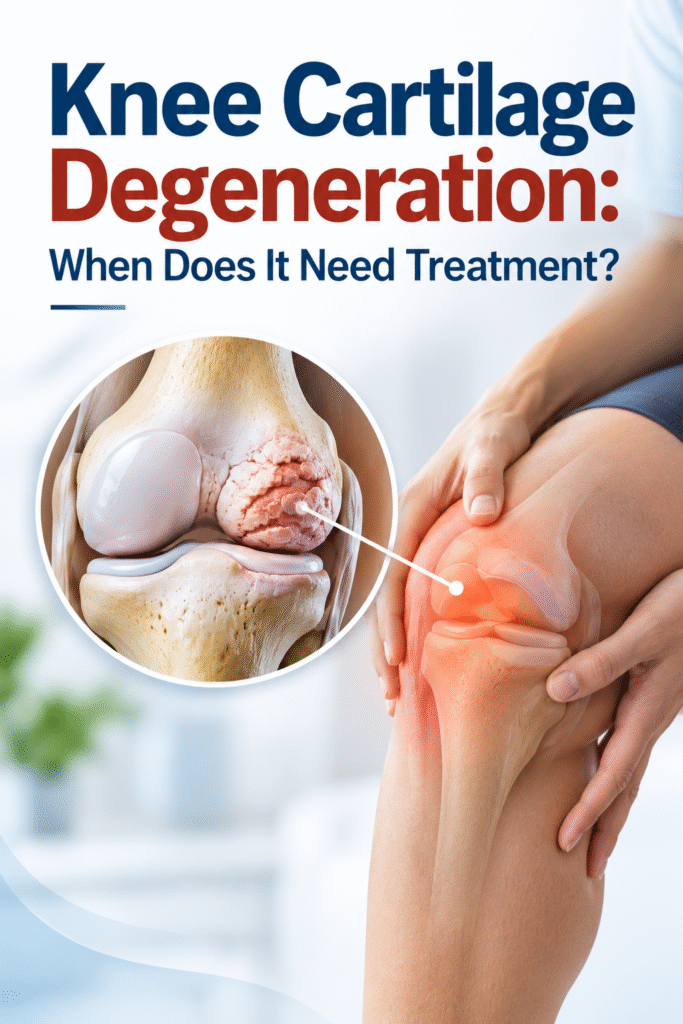
Knee pain is often associated with ageing, but persistent pain, stiffness, swelling, or difficulty with movement should not simply be considered a normal part of getting older. One possible cause is knee cartilage degeneration, in which the smooth cartilage that helps the knee bones move against each other gradually becomes damaged or worn.
Cartilage degeneration is commonly associated with osteoarthritis of the knee, although cartilage can also be damaged following sports injuries, fractures, ligament injuries, or other conditions.
Understanding the symptoms and seeking appropriate evaluation can help determine whether treatment is needed and which approach may be most suitable.
What Is Knee Cartilage?
The knee contains a smooth, resilient tissue called articular cartilage. It covers the ends of the thigh bone (femur), shin bone (tibia), and the back of the kneecap (patella).
This cartilage helps:
- Reduce friction between the bones
- Absorb and distribute forces through the knee
- Allow smooth joint movement
- Protect the underlying bone
Unlike many other tissues in the body, articular cartilage has a limited ability to heal itself because it has very little direct blood supply.
What Causes Knee Cartilage Degeneration?
Cartilage can gradually deteriorate for several reasons. Common risk factors include:
- Age-related wear: The risk of osteoarthritis increases with age.
- Previous knee injuries: Meniscus tears, ligament injuries, fractures, or previous joint trauma may increase the risk of later cartilage damage.
- Repetitive stress: Certain activities or occupations that place repeated stress on the knee may contribute to joint degeneration.
- Excess body weight: Higher body weight increases the mechanical load placed on the knee and is associated with a greater risk of knee osteoarthritis.
- Joint alignment problems: Abnormal alignment can place uneven stress on areas of cartilage.
- Genetic and metabolic factors: Some people may have a higher susceptibility to osteoarthritis and cartilage damage.
What Are the Symptoms of Cartilage Degeneration?
Symptoms can vary depending on the extent and location of cartilage damage.
Common symptoms include:
1. Knee Pain
Pain may initially occur during activities such as walking for longer periods, climbing stairs, squatting, or exercising. As degeneration progresses, pain may become more frequent.
2. Stiffness
The knee may feel stiff after waking up or after sitting for a prolonged period. Osteoarthritis-related morning stiffness typically lasts less than 30 minutes.
3. Swelling
Inflammation or excess fluid within the joint can cause swelling, particularly after increased activity.
4. Reduced Range of Motion
You may find it increasingly difficult to fully bend or straighten the knee.
5. Grating or Grinding Sensation
Some people experience a clicking, cracking, or grinding sensation, known as crepitus, when moving the knee.
6. Difficulty With Everyday Activities
As symptoms progress, activities such as climbing stairs, getting up from a chair, walking, or exercising may become increasingly uncomfortable.
Importantly, the severity of symptoms does not always correspond directly to the amount of cartilage damage seen on an X-ray or scan. A clinical assessment is therefore important.
When Does Knee Cartilage Degeneration Need Treatment?
Not every person with cartilage degeneration requires surgery. Treatment depends on factors such as pain severity, functional limitations, examination findings, age, activity level, underlying cause, and the extent of joint damage.
If symptoms are mild and do not significantly interfere with daily activities, an orthopedic specialist may initially recommend monitoring and conservative measures.
However, medical evaluation is advisable when:
- Knee pain persists or repeatedly returns
- Pain interferes with walking or daily activities
- Swelling occurs repeatedly
- Knee movement becomes restricted
- Symptoms are affecting sleep or exercise
- The knee feels unstable or gives way
- Pain continues despite basic self-care
- Symptoms develop after a significant knee injury
Early evaluation can help identify the underlying problem and guide appropriate treatment.
How Is Cartilage Degeneration Diagnosed?
An orthopedic evaluation generally begins with a discussion of symptoms, previous injuries, activity levels, and medical history, followed by a physical examination of the knee.
Depending on the suspected cause, investigations may include:
X-rays:
X-rays can show changes such as reduced joint space, bone spurs, and other features associated with osteoarthritis. However, cartilage itself is not directly visible on a standard X-ray.
MRI:
An MRI can provide detailed information about cartilage, menisci, ligaments, bone, and other soft tissues. It may be useful when a specific cartilage injury or another internal knee problem is suspected.
The need for imaging depends on the individual clinical situation. Not everyone with knee pain requires an MRI.
What Are the Treatment Options?
Treatment is usually tailored to the individual’s symptoms and the cause and severity of cartilage damage.
Exercise and Physiotherapy
A structured exercise program can help improve muscle strength, joint movement, balance, and overall knee function. Strengthening the quadriceps, hamstrings, and hip muscles may help improve support around the knee.
A physiotherapist can recommend exercises based on the individual’s condition and functional goals.
Weight Management
For people who are overweight or have obesity, gradual weight reduction can reduce stress on the knee and may improve pain and function in knee osteoarthritis.
Activity Modification
Temporarily reducing activities that significantly aggravate symptoms may help. Low-impact activities such as cycling, swimming, or water-based exercise may be better tolerated by some people.
Medicines
Depending on the individual, a doctor may recommend medications to help control pain and inflammation. The choice should consider factors such as age, other medical conditions, kidney and gastrointestinal health, and other medicines being taken.
Pain medicines should not be used routinely without appropriate medical advice.
Injections
In selected patients, injections may be considered when symptoms persist despite other treatments. Options can include corticosteroid injections and, in some settings, other injectable treatments.
The effectiveness and suitability of injections vary between patients, and they are not a way to restore completely worn cartilage.
Surgical Treatment
Surgery may be considered when significant symptoms persist despite appropriate non-surgical treatment or when there is a specific structural problem that can benefit from surgery.
Depending on the patient’s age, activity level, cartilage damage, alignment, and overall condition of the knee, surgical options may include procedures such as:
- Arthroscopic procedures in selected situations
- Cartilage restoration procedures for carefully selected focal cartilage defects
- Osteotomy for selected patients with specific alignment-related problems
- Partial or total knee replacement for advanced symptomatic arthritis when other treatments no longer provide adequate relief
Surgery is not automatically required simply because cartilage degeneration is visible on an imaging scan.
Can Knee Cartilage Grow Back Naturally?
Articular cartilage has a limited capacity for natural repair. Small or superficial cartilage injuries may sometimes remain stable, while more extensive cartilage loss generally does not simply grow back on its own.
However, this does not mean that every person with cartilage degeneration will eventually need a knee replacement. Appropriate exercise, weight management when applicable, activity modification, symptom management, and treatment of associated knee problems can help many people maintain function and manage symptoms.
Can Cartilage Degeneration Be Prevented?
Cartilage degeneration cannot always be prevented, particularly when age, genetics, or previous injuries play a role. However, several measures can support long-term knee health:
- Maintain a healthy body weight
- Keep the muscles around the knee strong
- Stay physically active with appropriate exercises
- Avoid rapidly increasing training intensity
- Use proper technique during sports and exercise
- Treat significant knee injuries appropriately
- Seek medical evaluation for persistent knee symptoms
When Should You See an Orthopedic Specialist?
Knee pain that persists, worsens, or interferes with normal activities deserves proper evaluation. This is particularly important if symptoms follow an injury, are associated with recurrent swelling, or are accompanied by reduced movement or instability.
An orthopedic specialist can determine whether the symptoms are related to cartilage degeneration, osteoarthritis, meniscus or ligament problems, or another condition.
Takeaway
Knee cartilage degeneration does not always mean surgery. The need for treatment depends on the cause of the cartilage damage, the severity of symptoms, how much the condition affects daily life, and the overall health of the knee.
Early assessment can help identify the problem and provide an appropriate treatment plan—whether that involves exercise and physiotherapy, lifestyle changes, medication, injections, or surgery when indicated.
Persistent knee pain should not be ignored. Consult an orthopedic specialist in Nigdi – PCMC for an accurate diagnosis and personalized treatment plan.